Showing posts with label London. Show all posts

Sunday, 17 April 2016

Anzac Day 1932 - Wellington's Carillon

A proposal to erect a National War Memorial in Wellington in 1919 was postponed owing to financial strains on the New Zealand economy caused by the war. The favoured proposal was to build a Carillon at Mt Cook. In 1930 the bells intended for Wellington's Carillon were erected in a special structure at Hyde Park in London for the inaugural recital before the bells were shipped to New Zealand. The carilloneur for the occasion was Mr Clifford Ball whose talent hailed from the Cadbury Brothers Carillon at the English town of Bournville. He was assisted at the recital by New Zealander, Miss Gladys Watkins who had studied carillon playing at Malines in Belgium.
In 1931 the steamer Ionic arrived at King's Wharf, Wellington. Her precious cargo included some of the big bells intended for temporary storage until the new Carillon was built.

On the afternoon of Anzac Day 1932 the National War Memorial Carillon was officially opened in front of a large audience of over 50,000 people at Buckle Street, Mount Cook, Wellington. Today its presence on the Wellington city's skyline is complemented by the Hall of Memories (1964) and the Tomb of the Unknown Warrior (2004) all of which are located at the Pukeahu National War Memorial Park opened in April 2015. What follows are a few early postcards of the Carillon, assorted newspaper information reporting on the grand occasion of its official opening and some personal photographs taken in recent years.
An early photographic postcard of the Carillon in Wellington taken by photographer Heaton Clairemont Peart. Note that the National Art Gallery and Dominion Museum buildings have not yet been built behind the tower. The Gallery and Museum were officially opened in 1936. 

A view of the Carillon from Mt Victoria Tunnel taken by Heaton Clairemont Peart.


(source: Evening Post, 20 April 1932)


(source: Evening Post, 23 April 1932)


(source: Evening Post, 23 April 1932)


(source: Auckland Weekly News, 4 May 1932)
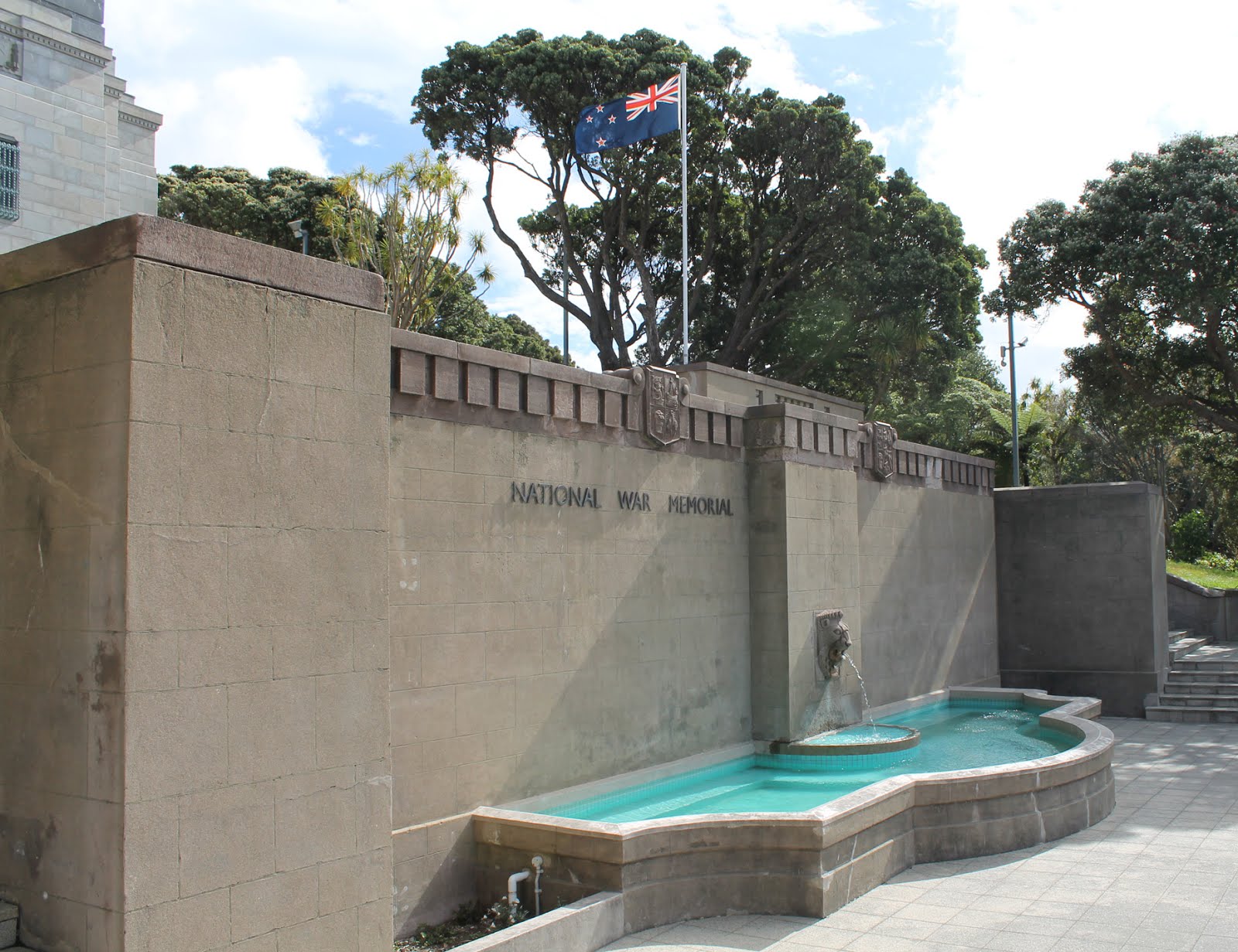

National War Memorial fountain and steps leading up to the Carillon. (2014)


War planes fly past the Carillon. Anzac Street Parade to Pukeahu War Memorial Park (24 April 2015).


Pukeahu War Memorial Park Sound and Light Show (2015)
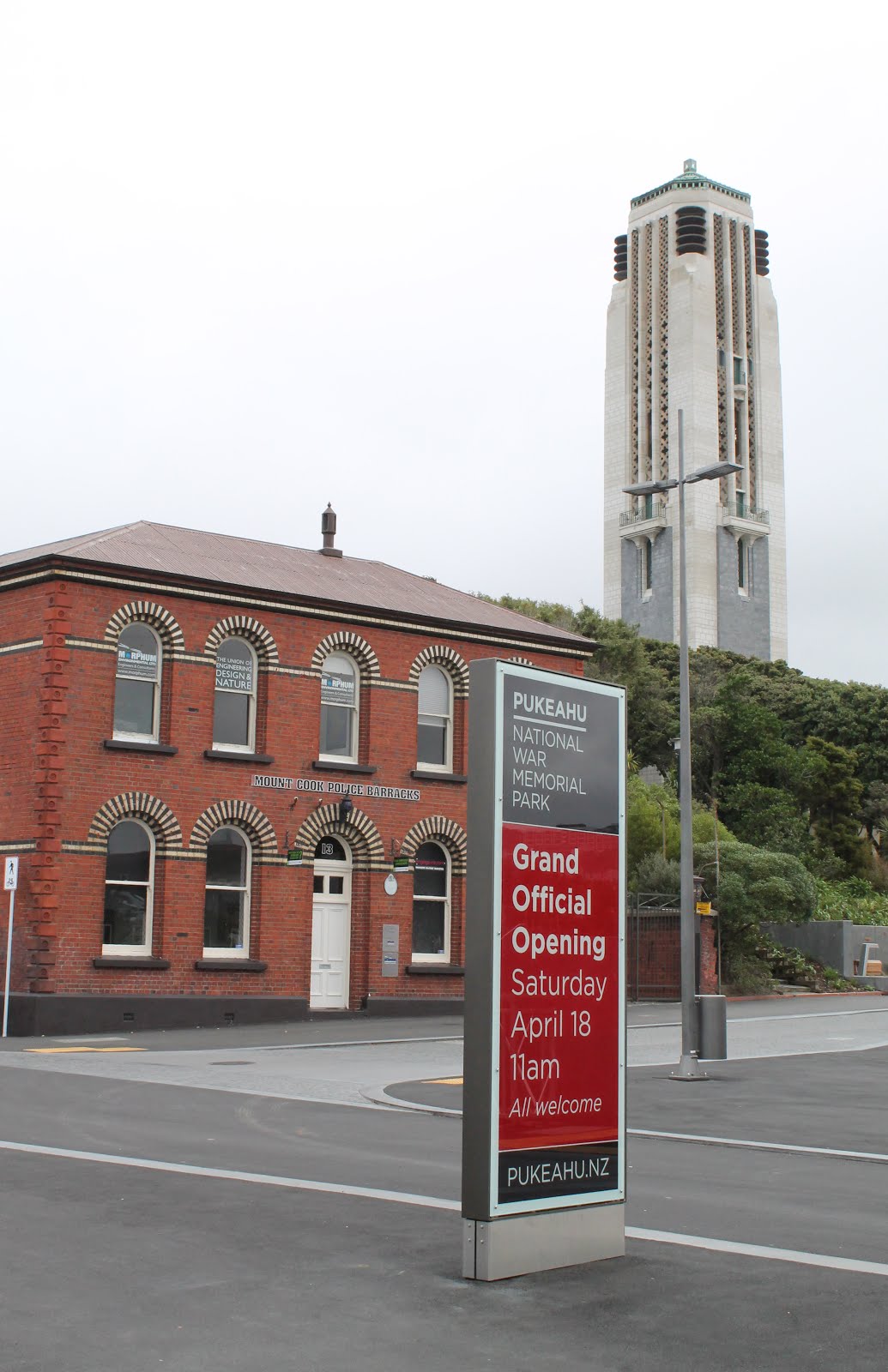


Left: Wellington Anzac Dawn Service at the National War Memorial Carillon on 25 April 2015.
Right - Grand official opening of Pukeahu National War Memorial Park on 18 April 2015.

Monday, 1 June 2015

Blinded

"Pals" postcard by artist George Soper. 

On the back of the postcard the printed message reads:

“The soldiers and sailors blinded in the war have learnt to be blind at St Dunstan’s in Regent Park and many are still learning. After their training they go to their own homes or are set up in new ones to carry on the trades they have mastered. Large sums of money are necessary for the after-care of these brave men who gave their sight for us in the war, and a permanent After-Care Branch which will look after them all their lives has been established by the National Institute for the Blind which asks for your practical sympathy on their behalf. Contributions will be gladly accepted by the Treasurer, National Institute for the Blind, Great Portland Street, W.1.”

A number of New Zealand soldiers who were blinded in the war were sent to St Dunstan’s hospital in Regent's Park, London for treatment. One of these soldiers was the New Zealand High Commissioner’s son, Trooper Clutha Mackenzie. Clutha, serving with the Wellington Mounted Rifles was deprived of his sight while in combat at Sari Bair in 1915. The force of a nearby shell explosion forced out both his eyes.


Clutha Mackenzie, Free Lance, 26 November 1915.


Clutha Mackenzie, Auckland Weekly News, 6 November 1919.


Sunday, 10 May 2015

Shakespeare Hut

“Y.M.C.A. Shakespeare Hut.” A real photographic postcard printed in England with a handwritten note, “my home in London”, written on the back. 

The Shakespeare Hut on the corner of Keppell and Gower Streets in London was close to the British Museum and offered free services to all sailors and soldiers in His Majesty’s Forces during the war. The hut had reading and writing rooms, a concert hall, library and accommodation. Meals were also available at low prices and were a welcome luxury when measured against the rations received on the frontline. Many New Zealand soldiers passed through the Shakespeare Hut doors when granted leave from their posting in Belgium and France.

Sunday, 8 December 2013

Christmas Pudding

Postcards, letters, items of clothing such as socks, gloves and scarves, cake and the traditional Christmas pudding were all sent from friends and loved ones at home in New Zealand to their soldiers thousands of miles away. These simple pleasures of home brought to New Zealand soldiers at the frontline trenches meant the world to these men. Our men in khaki were spending their livelihood in and out of danger, focussed on survival and of course with a mind to win the war and see peace finally restored. Christmas was a particularly difficult time for many. The season was meant to be festive and joyous, bringing goodwill to all men, and a time for family coming together. War brought an end to that.
Christmas gifts from home gave the soldiers a momentary distraction from the war causing them for that brief moment to reminisce and make a special heartfelt connection with the sender.


This British postcard was used and sent by the "Daily News" in London to acknowledge and thank all those who financially contributed to a subscription which helped supply soldiers with Christmas Pudding in December 1916. On the back of this postcard, the subscriber receiving thanks is a Miss Edith Mont of Willaston School in Cheshire. The message indicates that she donated 1 shilling which provides Christmas pudding for 2 soldiers at the Front. Recorded in finer print on the card is the various financial subscriptions which are proportioned to quantities of Christmas pudding from a single soldier to many;

"6d. supplies one man; 2/6 five; £1 1/- fifty; 31/6 a platoon; £3 3/- a squadron or battery; £5 5/- a company; £9 9/- an artillery brigade; £12 12/- a cavalry regiment; £21 an infantry battalion." 

Saturday, 30 November 2013

Postcards from Ted #4

"National Gallery, London." British postcard no.21299. 

Here is the last postcard and message I have in my collection from Ted...

"In the trenches, France, July 8th 1916.

Dear Vera,
I was very pleased indeed to receive your note, also the photo and glad to know you are doing so well. The roaring of these big guns gets on ones nerves but its all in the game. I visited this place while in London and while there I thoroughly enjoyed myself and everybody I met made me so welcome. I was beginning to think I was home for good. It was too good to be true, never mind, what does it matter as long as we win and I am sure of that someday. Live in hope. I am in splendid health and spirits and thats everything. I am always wondering how you are all doing. I had word from (home) and they are all splendid thank god. So bye bye, I remain your sincere friend, Ted, xxxxx"

Thursday, 28 November 2013

Postcards from Ted #3

"Leicester Square, London." British postcard no.21309.

"In the Trenches, France, June 29th 1916.

Dear Mrs Fanning,
I was  awfully pleased to receive your letter dated April 10th. Very sorry indeed to hear that you are suffering from the affects of your head and I sincerely hope you are much improved by the time this short epistle  reaches you. I am glad to state that I am in perfect health again. I am beginning to think that a soldier's life isn't the game its cracked up to be. One has to be on the alert the whole time and one misses all these good times and comforts but we are out to win and we are going to win. Our boys will show the Germans what the Anzacs are made of. I can't see an ending yet but sooner or later there will be something doing. I will now say bye bye for the present. Hoping to hear from you again soon. Yours sincerely Ted."

Monday, 25 November 2013

Postcards from Ted #2

"Law Courts & Fleet St., London." Postcard manufactured in Britain. No.21005.

"In the trenches, France, June 29th 1916.

Dear Hilda,
Once again I have the pleasure of writing to you, thanking you for your letter of April 10 and glad to know you are doing famous but sorry to hear that Vera had the misfortune to fall from the Tram but glad to know she's resting.Well I haven't seen Ern for quite a time. I think he must hide. I am always about when out of the trenches. Don't worry about him he is well back been in the Artillery. He will take every precaution. I hope to see you all in the near future. I will now say bye bye for the present. I remain your true friend, Ted.
Hoping to hear from you again soon. A fortnight ago I was in this place."

Sunday, 24 November 2013

Postcards from Ted #1

"Knightsbridge, London." A British postcard no.21403.

"In the Trenches, France. June 26th, 1916."

Dear Marion, 
I have much pleasure in writing you these few lines to let you know that I am doing famous and in good health. Hoping you are all the same. I have been home to London and 7 days leave and have been back a week now. I had a most enjoyable time and the people were so kind to me. I haven't heard from you for some time now but hope to shortly. I haven't seen Ern since we arrived at Marseilles. He is about here somewhere. It has been raining off and on for about a week and the mud is awful nevertheless we mustn't growl. We are here to beat those Huns and we will do it in time although I wish the whole concern was finished. I have just about had enough and my nerves are not the same as when I left N.Z. It makes me feel as though I have been a soldier for some...

"Ludgate Circus, London." A British postcard no.21002.

...considerable time when one hears of the 12 reinforcements arriving. If I were in N.Z. now I would certainly be ashamed to show myself. In London there are hundreds of young fellows in mufty who ought to be ashamed of themselves. I will write a letter next time. Sincerely hope you are all well. Give my kindest regards Doll at home and any inquiring friends. The Artillery duels are pretty severe at times but we have got the huns thinking our boys have been less successful against them twice now. You will no doubt see by the papers. I will now say bye bye for the present. Hoping to see you all some day. I remain yours sincerely, Ted xxxxxxxxx."