To help commemorate New Zealand's First World War Centenary I will share with you 100 postcards from my private collection. These include real photographic images, artistic depictions and some handwritten messages of heartache and sorrow.
Showing posts with label Wellington. Show all posts
Wednesday, 17 May 2017
Girls in Khaki
Two ladies identified only as Sylvia and Nell, dressed in khaki military uniform as a show of support to New Zealand soldiers on active service overseas.
This portrait postcard was taken at Alva Studios on Cuba Street in Wellington c.1915.
"The Alva Studio, 26 Cuba street, is now under entirely new management, Mr H. Fawson, a well-known Auckland photographer, having purchased the business. General alterations and improvements have been effected, and the studio is now one of the most up-to-date in the city. First-class work and entire satisfaction is guaranteed all patrons." NZ Times, 9 July 1915.
Sunday, 17 April 2016
Anzac Day 1932 - Wellington's Carillon
A proposal to erect a National War Memorial in Wellington in 1919 was postponed owing to financial strains on the New Zealand economy caused by the war. The favoured proposal was to build a Carillon at Mt Cook. In 1930 the bells intended for Wellington's Carillon were erected in a special structure at Hyde Park in London for the inaugural recital before the bells were shipped to New Zealand. The carilloneur for the occasion was Mr Clifford Ball whose talent hailed from the Cadbury Brothers Carillon at the English town of Bournville. He was assisted at the recital by New Zealander, Miss Gladys Watkins who had studied carillon playing at Malines in Belgium.
In 1931 the steamer Ionic arrived at King's Wharf, Wellington. Her precious cargo included some of the big bells intended for temporary storage until the new Carillon was built.
On the afternoon of Anzac Day 1932 the National War Memorial Carillon was officially opened in front of a large audience of over 50,000 people at Buckle Street, Mount Cook, Wellington. Today its presence on the Wellington city's skyline is complemented by the Hall of Memories (1964) and the Tomb of the Unknown Warrior (2004) all of which are located at the Pukeahu National War Memorial Park opened in April 2015. What follows are a few early postcards of the Carillon, assorted newspaper information reporting on the grand occasion of its official opening and some personal photographs taken in recent years.

(source: Evening Post, 20 April 1932)

(source: Evening Post, 23 April 1932)


(source: Evening Post, 23 April 1932)

(source: Auckland Weekly News, 4 May 1932)

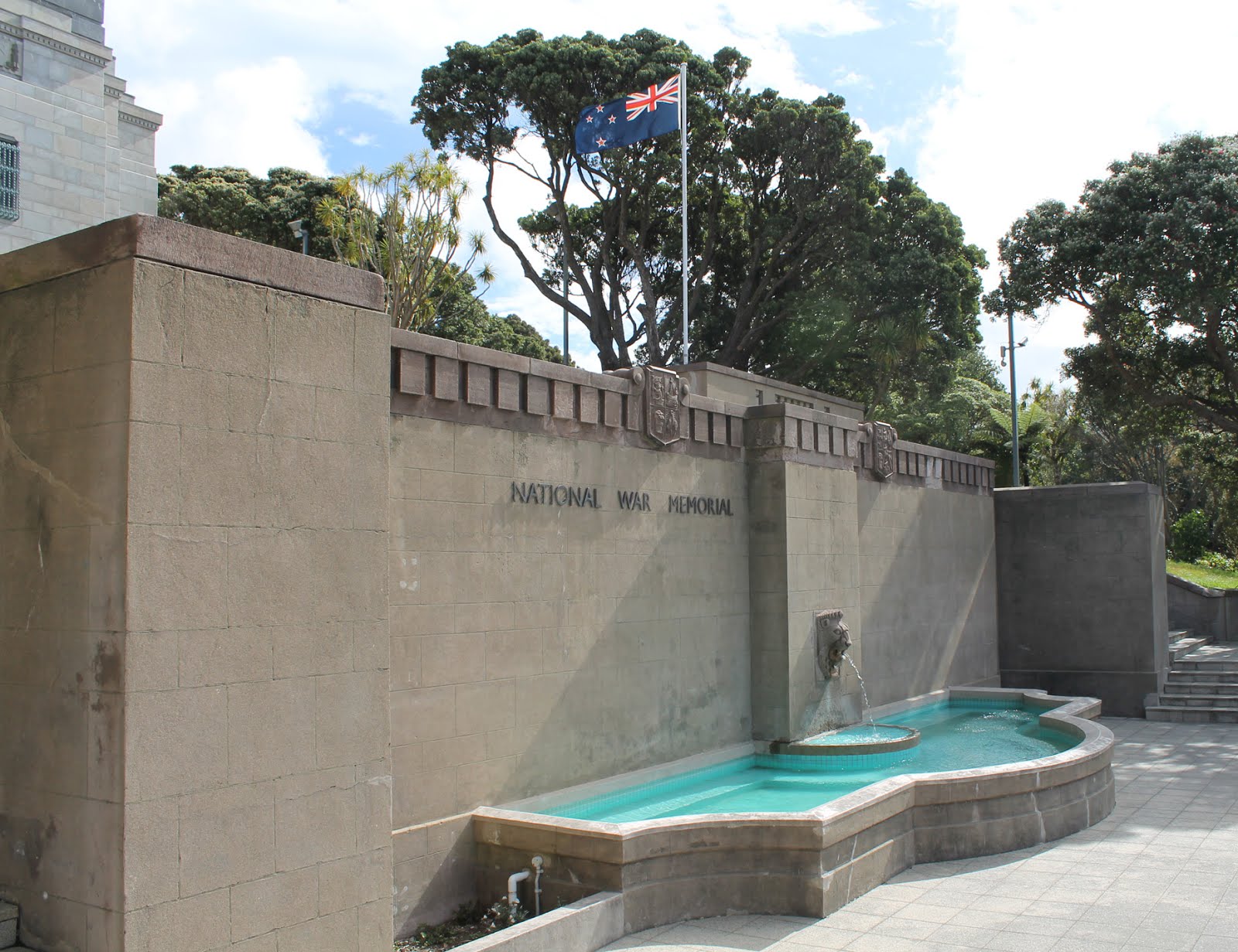
National War Memorial fountain and steps leading up to the Carillon. (2014)

War planes fly past the Carillon. Anzac Street Parade to Pukeahu War Memorial Park (24 April 2015).


Pukeahu War Memorial Park Sound and Light Show (2015)


Left: Wellington Anzac Dawn Service at the National War Memorial Carillon on 25 April 2015.
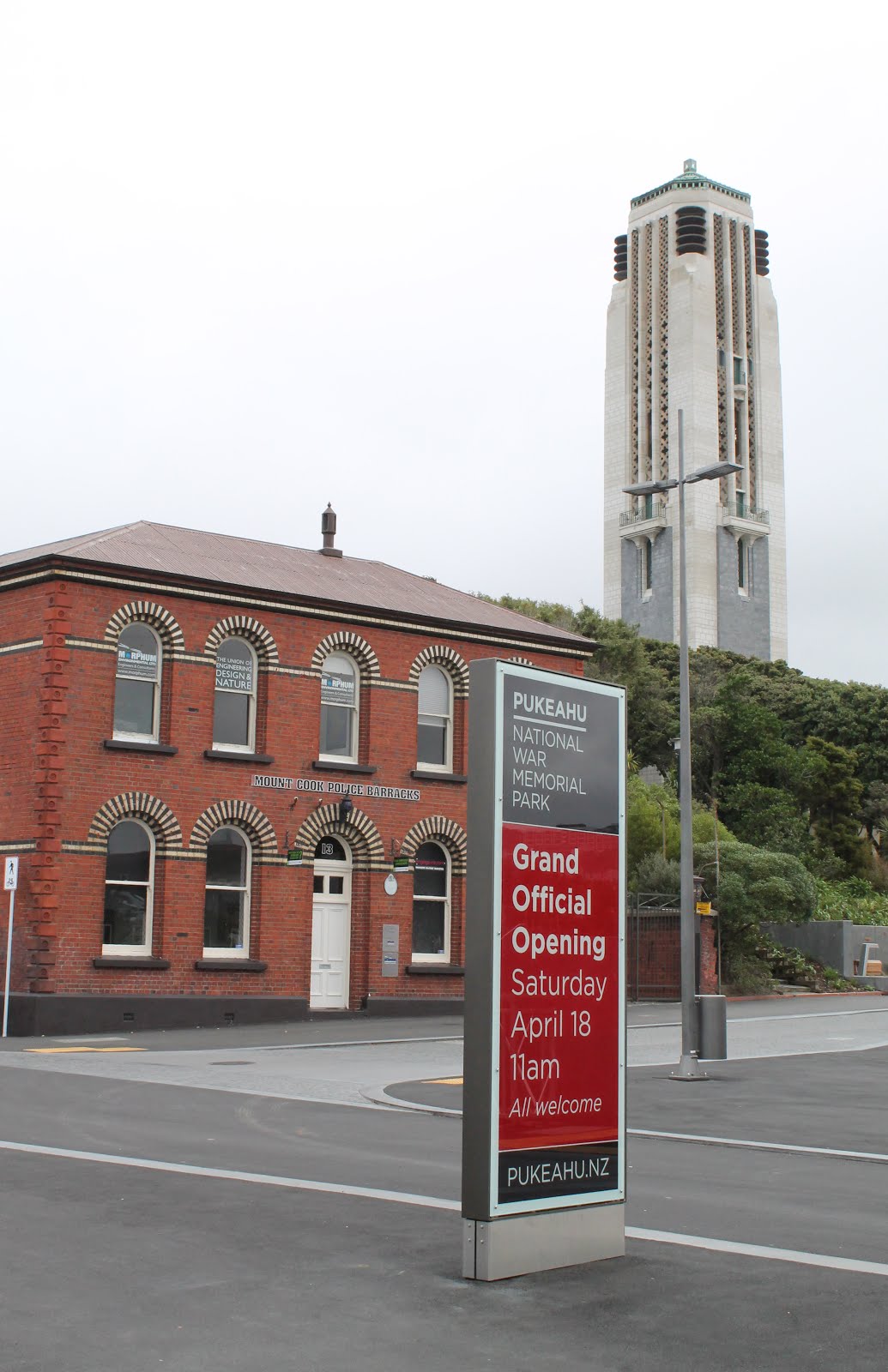
Right - Grand official opening of Pukeahu National War Memorial Park on 18 April 2015.
In 1931 the steamer Ionic arrived at King's Wharf, Wellington. Her precious cargo included some of the big bells intended for temporary storage until the new Carillon was built.
On the afternoon of Anzac Day 1932 the National War Memorial Carillon was officially opened in front of a large audience of over 50,000 people at Buckle Street, Mount Cook, Wellington. Today its presence on the Wellington city's skyline is complemented by the Hall of Memories (1964) and the Tomb of the Unknown Warrior (2004) all of which are located at the Pukeahu National War Memorial Park opened in April 2015. What follows are a few early postcards of the Carillon, assorted newspaper information reporting on the grand occasion of its official opening and some personal photographs taken in recent years.
An early photographic postcard of the Carillon in Wellington taken by photographer Heaton Clairemont Peart. Note that the National Art Gallery and Dominion Museum buildings have not yet been built behind the tower. The Gallery and Museum were officially opened in 1936.
A view of the Carillon from Mt Victoria Tunnel taken by Heaton Clairemont Peart.
(source: Evening Post, 20 April 1932)
(source: Evening Post, 23 April 1932)

(source: Auckland Weekly News, 4 May 1932)
National War Memorial fountain and steps leading up to the Carillon. (2014)
War planes fly past the Carillon. Anzac Street Parade to Pukeahu War Memorial Park (24 April 2015).


Pukeahu War Memorial Park Sound and Light Show (2015)
Left: Wellington Anzac Dawn Service at the National War Memorial Carillon on 25 April 2015.
Right - Grand official opening of Pukeahu National War Memorial Park on 18 April 2015.
Wednesday, 12 March 2014
Armentieres
"Armentieres. - La Rue du Pont de Flandre." published by Louis Levy ("L.L."), Paris.
The New Zealanders arrived in France in April 1916 and by May they were stationed in the Armentieres sector. New Zealand soldiers quickly discovered that the French town of Armentieres was a 'hot spot' for enemy shelling and the town and its outskirts would long be remembered by them as the scene for some of their first experiences of trench warfare and heavy bombardment.
Armentieres is located in northern France very close to the border of Belgium. To the west of the town, 453 New Zealand soldiers' graves lie in the largest New Zealand military cemetery in France, the Cite Bonjean Military Cemetery. One of the soldiers buried there is Private Robert John Cook, an 18 year old Wellingtonian who died of wounds in May 1916 and whose name is inscribed on the bell "Armentieres" at the National War Memorial Carillon in Wellington, New Zealand.
The French town is also famously referred to in the popular war song "Mademoiselle from Armentieres". There were many verses and all were sung with such vigour by soldiers on their march to war;
Oh, Mademoiselle from Armentieres,
Parley-vous
Oh, Mademoiselle from Armentieres,
Parley-vous
Mademoiselle from Armentieres,
She hasn't been kissed for forty years!
Hinky-dinky, parlez-vous?
Oh, Mademoiselle from Armentieres,
Parley-vous
Oh, Mademoiselle from Armentieres,
Parley-vous
You might forget the gas and shell
But you'll nev'r forget the Mademoiselle!
Hinky-dinky, parlez-vous?
Oh, Mademoiselle from Armentieres,
Parley-vous
Oh, Mademoiselle from Armentieres,
Parley-vous
Where are the girls who used to swarm
About me in my uniform?
Hinky-dinky, parlez-vous?
Monday, 9 December 2013
Christmas Pudding - Another Serving
From the early stages of the war it became apparent that the world trade markets would be affected by the widespread conflict. Here in New Zealand, food supply was just one example of this;
"The Xmas Pudding.
It is only six weeks till Christmas, and many housewives have the idea that Xmas puddings should be made early, and allowed to improve with keeping. Here another small problem presents itself. The entrance of Turkey into the war means that the market for dried fruits, already bare, is going to be pretty well cleaned out. Sultanas, figs, and dates in particular are going to be in short supply, and prices are going up accordingly." (Auckland Star, 10 November 1914).
"The Xmas Pudding.
It is only six weeks till Christmas, and many housewives have the idea that Xmas puddings should be made early, and allowed to improve with keeping. Here another small problem presents itself. The entrance of Turkey into the war means that the market for dried fruits, already bare, is going to be pretty well cleaned out. Sultanas, figs, and dates in particular are going to be in short supply, and prices are going up accordingly." (Auckland Star, 10 November 1914).
Auckland Weekly News 7 October 1915.
Despite these setbacks, Xmas pudding remained on the menu. In Wellington the Mayoress roused considerable support for the Christmas Pudding Fund. School children in particular, were keen fundraisers and contributors to the Fund. In July 1918 the Mayoress and her committee set to work on making a large number of the puddings. The Meat Export Company who operated out of Ngauranga Gorge kindly provided the committee with large enough premises to work in. The company also extended further support to the pudding makers by providing them a well earned lunch. The ingredients for the pudding were made possible by many supporters and donors; butter from D.J. Nathan & Co. and McEwen & Co.; bread from Messrs Kellow, Denhard, James, Raven, Lawrence, Flint and the Wellington Bread Co.; flour from Messrs J. Macintosh, Wright, Stephenson & Co.; eggs sourced from Carterton per the Mayoress, and Pahiatua per Mrs Thomson; suet from the Gear Company, E.Barber & Co., and the Wairarapa Farmers' Meat Company; and sugar from the Colonial Sugar Company in Auckland.
The preparation of these Christmas parcels also included thousands of signed postcards enabling the troops to easily post acknowledgement back to the school children who helped to make it all possible. Final send off of the parcels had to be made by about August to enable suitable guarantee of delivery of goods by christmastime to the war zone.
British postcard published by A.W. Ford & Co. Ltd, Printers, Bristol. Postmarked December 1914.
Printed on the back is the following message "Extract from Officers Letter At The Front. 'What I should really like are several large Plum Puddings sent out at different times so as not to be too heavy; we absolutely crave for something sweet out here.' "
Sunday, 14 July 2013
The Tragic Loss Of The Aparima And Her Crew
The Union Steamship Company of New Zealand's ship Aparima left London for Barry in South Wales to take on a load of coal in November 1917. When in service as a troopship she was renowned for being a slow traveller managing a maximum speed of only 12 to 13 knots. As she sailed down through the English Channel, her skipper Captain James Gerald Stokely Doorly took her as close to the coast as he dared, and set the Aparima on a zig zag course, both measures taken to give the vessel the best opportunity to avoid an attack by a German U-boat.
As the Aparima sailed passed the Isle of Wight and held a course about 4 kilometres south west of Anvil Point, German U-boat 40 under the command of Oberleutnant Hans Howaldt fired a torpedo in to her port side. The sudden explosion happened at about 12.50 a.m. on 19 November 1917, and within 8 minutes the Aparima was sunk.
Of the 110 crew onboard, 56 were tragically lost. The Aparima's crew included men from Britain, India, Australia and New Zealand. Among those who lost their lives were seventeen cadets whose sleeping quarters had been close to where the torpedo had struck.
The New Zealanders who were killed on the Aparima;
Cadet Walter James Bannantyne
Cadet Geoffrey Robert Bargrove
First Officer Harry Archibald Daniel
Cadet Donovan O'Bryen Hoare
Cadet Ian Kenneth MacKenzie
Cadet Adam Houliston Marshall
Cadet Robert Joseph Marshall
Cadet Leon Joseph Massey
Cadet Colin Boyd McDonald
Wireless Robert Perrett Taipo Millington
Cadet John Frederick Proudfoot
Cadet Alexander McKinley Ramsay
Chief Engineer Thomas Rogerson
Cadet William Shaw
Cadet John Gordon Smith
Cadet William Harry Williams
"Officers of the ill-fated steamer Aparima, including some who were lost when the vessel was torpedoed in the English Channel." Source: Auckland Weekly News, 13 December 1917, page 42.
From left to right, standing: Mr G. McDonald, missing; Mr Thomas Rogerson, chief engineer, missing; Mr Harry Daniel, chief officer, missing; Mr James Mackie, chief steward, missing; and Mr N.S. Fleming, fifth engineer.
Sitting front row: Mr G.S. Dalgliesh, who left the ship before its ill-fated voyage; Mr W.B. Hirst, second engineer; Mr A.F. Vipan, wireless operator; and Mr Maurice H. Mayo, seventh engineer.
Captain Doorly, born in Trinidad, survived the sinking of the Aparima. He jumped overboard in to the sea and was lucky enough to be picked up by one of the lifeboats. He had been under the employ of the Union Steam Ship Company of New Zealand since 1905. He married Ina Muriel Whitson in Dunedin in 1908. During the First World War he was Master of troopships Navua (1915 and 1916) and Aparima (1917). After the war ended, his career continued on the seas and in the mid 1920's he joined the Port Phillip Sea Pilot's Service in Melbourne, Australia. Doorly also enjoyed some success as an author and musician. In 1951 he returned to New Zealand and five years later, died in Wellington.
Portrait of Captain James Gerald Stokely Doorly and memorial plaque at Karori Cemetery, Wellington.
Before the tragic loss of the Aparima during the war, she had enjoyed some success as a cargo steamship on the Union Steam Ship Company's India service having made over thirty voyages to Calcutta. When war broke out, the Aparima was requistioned as a troopship by the New Zealand Government. As HMNZT 19, 26, 32 and 46 she carried New Zealand soldiers to Egypt. By April 1916, many New Zealand soldiers were deployed to Western Europe and the Aparima as HMNZT 61 and 76 journeyed to England.
As the Aparima sailed passed the Isle of Wight and held a course about 4 kilometres south west of Anvil Point, German U-boat 40 under the command of Oberleutnant Hans Howaldt fired a torpedo in to her port side. The sudden explosion happened at about 12.50 a.m. on 19 November 1917, and within 8 minutes the Aparima was sunk.
Of the 110 crew onboard, 56 were tragically lost. The Aparima's crew included men from Britain, India, Australia and New Zealand. Among those who lost their lives were seventeen cadets whose sleeping quarters had been close to where the torpedo had struck.
The New Zealanders who were killed on the Aparima;
Cadet Walter James Bannantyne
Cadet Geoffrey Robert Bargrove
First Officer Harry Archibald Daniel
Cadet Donovan O'Bryen Hoare
Cadet Ian Kenneth MacKenzie
Cadet Adam Houliston Marshall
Cadet Robert Joseph Marshall
Cadet Leon Joseph Massey
Cadet Colin Boyd McDonald
Wireless Robert Perrett Taipo Millington
Cadet John Frederick Proudfoot
Cadet Alexander McKinley Ramsay
Chief Engineer Thomas Rogerson
Cadet William Shaw
Cadet John Gordon Smith
Cadet William Harry Williams
"Officers of the ill-fated steamer Aparima, including some who were lost when the vessel was torpedoed in the English Channel." Source: Auckland Weekly News, 13 December 1917, page 42.
From left to right, standing: Mr G. McDonald, missing; Mr Thomas Rogerson, chief engineer, missing; Mr Harry Daniel, chief officer, missing; Mr James Mackie, chief steward, missing; and Mr N.S. Fleming, fifth engineer.
Sitting front row: Mr G.S. Dalgliesh, who left the ship before its ill-fated voyage; Mr W.B. Hirst, second engineer; Mr A.F. Vipan, wireless operator; and Mr Maurice H. Mayo, seventh engineer.
Captain Doorly, born in Trinidad, survived the sinking of the Aparima. He jumped overboard in to the sea and was lucky enough to be picked up by one of the lifeboats. He had been under the employ of the Union Steam Ship Company of New Zealand since 1905. He married Ina Muriel Whitson in Dunedin in 1908. During the First World War he was Master of troopships Navua (1915 and 1916) and Aparima (1917). After the war ended, his career continued on the seas and in the mid 1920's he joined the Port Phillip Sea Pilot's Service in Melbourne, Australia. Doorly also enjoyed some success as an author and musician. In 1951 he returned to New Zealand and five years later, died in Wellington.
Portrait of Captain James Gerald Stokely Doorly and memorial plaque at Karori Cemetery, Wellington.
Before the tragic loss of the Aparima during the war, she had enjoyed some success as a cargo steamship on the Union Steam Ship Company's India service having made over thirty voyages to Calcutta. When war broke out, the Aparima was requistioned as a troopship by the New Zealand Government. As HMNZT 19, 26, 32 and 46 she carried New Zealand soldiers to Egypt. By April 1916, many New Zealand soldiers were deployed to Western Europe and the Aparima as HMNZT 61 and 76 journeyed to England.
S.S. Aparima, H.M.N.Z.T. No.32.
October 1915. Real photographic postcard by J. Dickie.
Written on the back of this postcard;
"Nov 5th.
217 Cuba St
Wellington
Dear May, These are the 5 boats that left with 7th Reinforcements. Thought you would like to have all the boats. This one was the last to leave the wharf. It was there 10 past 6 and the sun was almost down. Writing to mother soon. Received letter today. Love to all, Annie."
Today, the wreck of the Aparima lies at a depth of 42 metres on the bottom of the English Channel, about 4 kilometres south west of Anvil Point, England. This 5,700 ton wreck is said to stand 8 metres high in places, is 430 feet long, and various items of the ship such as the 4.7inch gun, mooring cable and anchor are still visible and intact for divers to explore.
Labels:
Anvil Point,
Aparima,
Calcutta,
Captain James Doorly,
Karori,
Melbourne,
Navua,
Oberleutnant Howaldt,
Port Phillip Sea Pilot Service,
torpedo,
UB40,
Union Steamship Company of NZ,
Wellington
Thursday, 14 February 2013
From life's tree a leaf has fallen
The familiar face of Lord Kitchener seen here on a large calico banner hanging from the Bank of New Zealand on Lambton Quay and the bottom of Willis Street in Wellington.
This large recruiting sign has the quotation from one of Kitchener's speeches;
"Give me the men and munitions I want and I will guarantee my personal reputation that we hold the war in the hollow of our hands."
This real photographic postcard is dated to October 1915. With just a little over seven months later, Field Marshal Horatio Herbert Kitchener was killed when HMS Hampshire was sunk by a German mine a few kilometres off the coast of the Orkney Islands on 5 June 1916.
Subscribe to:
Posts (Atom)