Sunday, 14 July 2013

The Tragic Loss Of The Aparima And Her Crew

The Union Steamship Company of New Zealand's ship Aparima left London for Barry in South Wales to take on a load of coal in November 1917. When in service as a troopship she was renowned for being a slow traveller managing a maximum speed of only 12 to 13 knots. As she sailed down through the English Channel, her skipper Captain James Gerald Stokely Doorly took her as close to the coast as he dared, and set the Aparima on a zig zag course, both measures taken to give the vessel the best opportunity to avoid an attack by a German U-boat.
As the Aparima sailed passed the Isle of Wight and held a course about 4 kilometres south west of Anvil Point, German U-boat 40 under the command of Oberleutnant Hans Howaldt fired a torpedo in to her port side. The sudden explosion happened at about 12.50 a.m. on 19 November 1917, and within 8 minutes the Aparima was sunk.
Of the 110 crew onboard, 56 were tragically lost. The Aparima's crew included men from Britain, India, Australia and New Zealand. Among those who lost their lives were seventeen cadets whose sleeping quarters had been close to where the torpedo had struck.
The New Zealanders who were killed on the Aparima;

Cadet Walter James Bannantyne
Cadet Geoffrey Robert Bargrove
First Officer Harry Archibald Daniel
Cadet Donovan O'Bryen Hoare
Cadet Ian Kenneth MacKenzie
Cadet Adam Houliston Marshall
Cadet Robert Joseph Marshall
Cadet Leon Joseph Massey
Cadet Colin Boyd McDonald
Wireless Robert Perrett Taipo Millington
Cadet John Frederick Proudfoot
Cadet Alexander McKinley Ramsay
Chief Engineer Thomas Rogerson
Cadet William Shaw
Cadet John Gordon Smith
Cadet William Harry Williams

"Officers of the ill-fated steamer Aparima, including some who were lost when the vessel was torpedoed in the English Channel." Source: Auckland Weekly News, 13 December 1917, page 42.
From left to right, standing: Mr G. McDonald, missing; Mr Thomas Rogerson, chief engineer, missing; Mr Harry Daniel, chief officer, missing; Mr James Mackie, chief steward, missing; and Mr N.S. Fleming, fifth engineer. 
Sitting front row: Mr G.S. Dalgliesh, who left the ship before its ill-fated voyage; Mr W.B. Hirst, second engineer; Mr A.F. Vipan, wireless operator; and Mr Maurice H. Mayo, seventh engineer.

Captain Doorly, born in Trinidad, survived the sinking of the Aparima. He jumped overboard in to the sea and was lucky enough to be picked up by one of the lifeboats. He had been under the employ of the Union Steam Ship Company of New Zealand since 1905. He married Ina Muriel Whitson in Dunedin in 1908. During the First World War he was Master of troopships Navua (1915 and 1916) and Aparima (1917). After the war ended, his career continued on the seas and in the mid 1920's he joined the Port Phillip Sea Pilot's Service in Melbourne, Australia. Doorly also enjoyed some success as an author and musician. In 1951 he returned to New Zealand and five years later, died in Wellington.


Portrait of Captain James Gerald Stokely Doorly and memorial plaque at Karori Cemetery, Wellington.

Before the tragic loss of the Aparima during the war, she had enjoyed some success as a cargo steamship on the Union Steam Ship Company's India service having made over thirty voyages to Calcutta. When war broke out, the Aparima was requistioned as a troopship by the New Zealand Government. As HMNZT 19, 26, 32 and 46 she carried New Zealand soldiers to Egypt. By April 1916, many New Zealand soldiers were deployed to Western Europe and the Aparima as HMNZT 61 and 76 journeyed to England.

S.S. Aparima, H.M.N.Z.T. No.32. 
October 1915. Real photographic postcard by J. Dickie.

Written on the back of this postcard;
"Nov 5th.
217 Cuba St
Wellington

Dear May, These are the 5 boats that left with 7th Reinforcements. Thought you would like to have all the boats. This one was the last to leave the wharf. It was there 10 past 6 and the sun was almost down. Writing to mother soon. Received letter today. Love to all, Annie."

Today, the wreck of the Aparima lies at a depth of 42 metres on the bottom of the English Channel, about 4 kilometres south west of Anvil Point, England. This 5,700 ton wreck is said to stand 8 metres high in places, is 430 feet long, and various items of the ship such as the 4.7inch gun, mooring cable and anchor are still visible and intact for divers to explore.

Sunday, 7 July 2013

Colonial Badges and their Wearers - by artist Harry Payne

Set: Colonial Badges and their Wearers.
No. 3160
"New Zealand. By many brave and heroic deeds has the motto of the New Zealand fighting man, "Onward" been upheld by these smart and soldierly troops. Proudly will they be able to tell their sons and grandsons how they helped the Mother Country in her hour of need in the Great War. Their hats are distinguished by the bands, red for Infantry and green for Light Cavalry. The cap badge formerly was one plain fern leaf, but the one here shown is now universally used."


Set: Colonial Badges and their Wearers.
No. 3160
"Australia. The whole world now knows of the important and brilliant achievements of the Australians in this the greatest and fiercest war in history, how they have time and again gone in the thickest of the fight to win a certain position and to keep it when gained. The black badge is universal with all Australian troops and is worn on the flap of the hat. The regimental badges are worn on the collar."


Set: Colonial Badges and their Wearers.
No. 3160
"Newfoundland.  Although Newfoundland may not be a very thickly populated country, she has been able to send a find body of sturdy troops to help the Mother Country in her hour of need, and the sons she sent have done bravely and well in many a hard fought action. Their badge is a striking design of and Elk or Reindeer and is worn on the service cap and the collar."


Set: Colonial Badges and their Wearers.
No. 3160
"Canada. Until a few years ago the various regiments of Canada possessed their own distinctive titles, such, for instance, as the "Winnipeg Rifles", the "Three Rivers Infantry", etc, but they are now known only by the number of the battalion. The universal badge of the maple leaf is worn, with very few exceptions, on the cap and the battalion badge on the collar. The homage and gratitude of the whole Empire goes out to the Canadians for the heroic part they have played in the Great War."


Pictured are four postcards from a set of six painted by the popular British artist Harry Payne (1858 - 1927) and entitled Colonial Badges and their Wearers. Harry worked with the large postcard publishing house of Raphael Tuck and Sons from 1884 right through until the end of the First World War. This Oilette set which includes two other postcards not pictured, Canadian Cavalry and South African Infantry, was one of many sets Harry Payne produced for Raphael Tuck. He also produced postcards for publisher Gale and Polden. His older brother Arthur Charles Payne was also an accomplished artist and sometimes worked with his brother to produce fine pieces of work. Harry was a prolific artist of portrait and landscape painting while his brother Arthur specialised in architectural subjects. Their collaboration often meant that Arthur would paint the background and Harry the figure portraits.
Harry Payne painted many other postcards of soldiers during the First World War and all of these portrayed their uniformed subjects in excellent detail. It is for this reason that Harry Payne's postcards are keenly sought by collectors today.

Friday, 28 June 2013

The Beautiful Game and The Ugly War

The news this week that the British Government plan to hold a football match between England and Germany on Boxing Day 2014 at Messines in Belgium has inspired me to write this post.

The First World War was an ugly tragic mess that claimed millions of lives. Many survivors would not or could not speak of the grim conditions they endured during the war years. However, on rare occasions, a glimmer of hope and humanity prevailed. An early example of this was the Christmas  truce of 1914. On the cold bleak battlefront the human spirit and goodwill to all men was ignited when British soldiers saw candlelit Christmas trees perched up on the German trench parapets. A biting chill in the air on Christmas eve suddenly carried the warming sound of carols and with it, the curiosity and temptation for both sides to somehow rejoice and sing along. One thing led to another, and chocolate, christmas pudding and other goods sent from home were exchanged by throwing them between British and German trenches.And then the remarkable truce followed. The first British and German soldiers to climb out of their trenches to face one another unarmed must surely have been anxious but bold. The final act of coming together in the middle of no-mans land was without doubt a momentous occasion with the purpose of sharing and celebrating  Christmas.
But as if this was not enough inspiration and goodwill, at various locations along the front line German and Allied battalions came together to play the beautiful game! If the traditional leather football was not available then footballs were soon fashioned out of fabric stuffed with straw, tied up sandbags, and even a ration tin. Regimental hats were crudely used to mark the goal posts, but no matter, the spirit, comraderie and shared passion for football were all that mattered for those brief moments at Christmas in 1914.
When the games ended, and the Christmas celebrations came to a close, soldiers from both sides returned to their trenches, picked up their weapons and resumed the war. Many of those men later fell on the same shell scarred landscape that they had briefly come together to share Christmas and football on.

German prisoner-of-war football team near Messines, Belgium in June 1917.

So, it is with great admiration I have for the British government in their decision to arrange a football match intended to honour the fallen from both sides and to mark the centenary of the 1914 Christmas truce. And what better player ambassador to lead England, than David Beckham. A player built on passion for the game, who exercises true sportsmanship, and a person who can be guaranteed to provide a genuine warm handshake before and after the game. I wouldn't mind seeing our own Ryan Nelsen in the team too, if there were a chance for his inclusion.

It is worth mentioning that whilst rugby is in our New Zealand blood, and matches were played not far from the war zone, football too, was revered during that same period. This hardened bunch of New Zealand soldiers seen below, were a  team from 1916. I wonder whether they ever had the opportunity like those men from the 1914 truce, to be able to lay down weapons at Christmas and have a good old dribble and kick against a German side. What's certain is that any Kiwi side with solid focus and determination is hard to beat. The All Whites punched above their weight against the much higher ranked Italy in the 2010 World Cup. So who knows, maybe there was a Beckham equivalent in this New Zealand army team!

I only hope we have a New Zealand presence at the centenary football match next year so that we might share in the remembrance of all those who were robbed of longer, happier, healthier lives and who instead could only scrape together some small opportunity to play sport together for one brief moment at Christmastime one hundred years ago.

Anzac football team at Rouen, France in 1916.

Sunday, 16 June 2013

"With Sturdy Stride They March Away" - the March over the Rimutaka Ranges


"With sturdy stride they march away
To the roll of the kettle-drums brave,
To cheery trumpets blare and play
And the starry banners wave.
They need no spurs to urge them on;
Their hearts are beating fast,
And tear-bright eyes have smiled and shone
As rank on rank swept past.
From columns deep of marching feet
The dust-clouds scatter and blow,
And boom-boom-boom! the big drums beat
To let the nations know..."
From  a song written by Will Lawson (1876-1957).

The Fifteenth Reinforcement marching from Featherston Military Camp over the Rimutaka Ranges and down to Trentham Camp in the Hutt Valley.
Real photographic postcard taken by John Roger Stewart, 6 July 1916.

Over 60,000 New Zealand men trained to become soldiers at Featherston Military Camp during the First World War. At the end of their training at Featherston, many of these soldiers marched from camp over the Rimutakas along its gravelled road. They stopped for a refreshments break at the Rimutaka Road Summit and bivouacked overnight near Kaitoke (and some reinforcements a second time at Mangaroa Valley) before arrival at Trentham Camp.

It was a journey of approximately 34 kilometres and was often photographed for postcard souvenirs. Prominent photographers whose work included images of either Featherston and Trentham camps, or the Rimutaka marches include; Private John Bernard Arnold, Bickerton, Henry Brett, James Henry Daroux, Allan Mackenzie, Luther Mence, Private Percy Caz Sorrell, Rifleman James Roger Stewart, and Private Tom Varley.

Real photographic postcard showing some of the men from B Company Sixteenth Reinforcement on a refreshments break whilst on their way over the Rimutakas to Trentham Camp c.May 1916.

This postcard was written on the back by Private James Marshall Lawrence of B Company 16th Reinforcement;
"Dear Irene, I was going to send you a button off my uniform, but as we are going to Christchurch to parade there, I will have to keep them on, so I am sending you this P.C. instead, as a little keepsake from this little soldier. Kind regards to Father and Mother. Thank him very much for those addresses he was going to send me. Not goodbye, just so long.
From Corpl J.M. Lawrence, 16ths (Record Breakers)"
James received a gunshot wound to his right hand in June 1917 but returned to New Zealand after the war ended, safe and well.

"The march of the Sixteenth Reinforcements from Featherston to Trentham took place on Sunday. Of nine companies in the draft, five marched as far as Kaitoke, and the others, A, B, C and J companies, marched all the way to Trentham. This was the first time this has been done. The little bootmaker mascot of the Fifteenths joined the column at Trentham, and marched all the way to Trentham. The Sixteenths are regarded as the strongest draft that has yet crossed the Rimutakas."
Source: Colonist, 9 August 1916


Two separate postcards help form this wonderful panoramic view of the 23rd Reinforcement marching from the Rimutaka Ranges and down in to Kaitoke. They are seen here crossing the Pakuratahi River on 15 February 1917. The photographs were taken by Nelson-born John Bernard Arnold, who later in the year  was recruited in to D Company at Trentham Military Camp.


Almost at destination end! These New Zealand soldiers have crossed the railway line evident by the crossing sign seen in the background. The sound of marching boots and the cloud of rising dust have drawn the attention from a family looking on from their verandah. These soldiers are likely making their way along Sunderland Avenue, just a short distance away from Trentham Camp.

Sunday, 9 June 2013

Barrage Gardens, Cairo

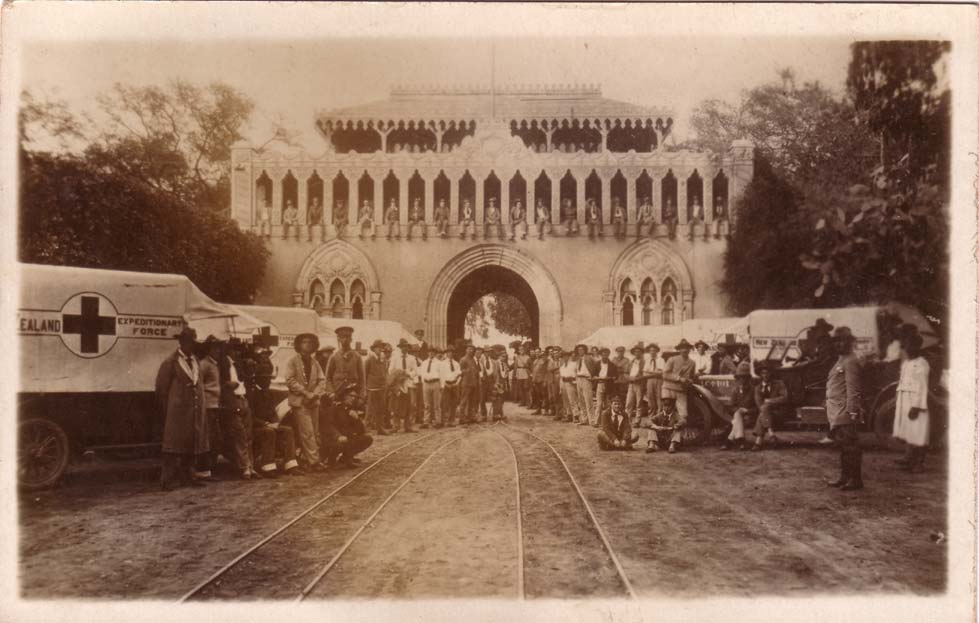
c.1916. Convalescent New Zealand soldiers and medical staff stood beside New Zealand Expeditionary Force ambulances at the Barrage Gardens, approximately 20 miles from Cairo in Egypt. This group portrait photographic postcard was taken on a day's outing at the gardens whilst enjoying a picnic.